
Leona’s Workshop: an immersive WordPress platform for an independent artist
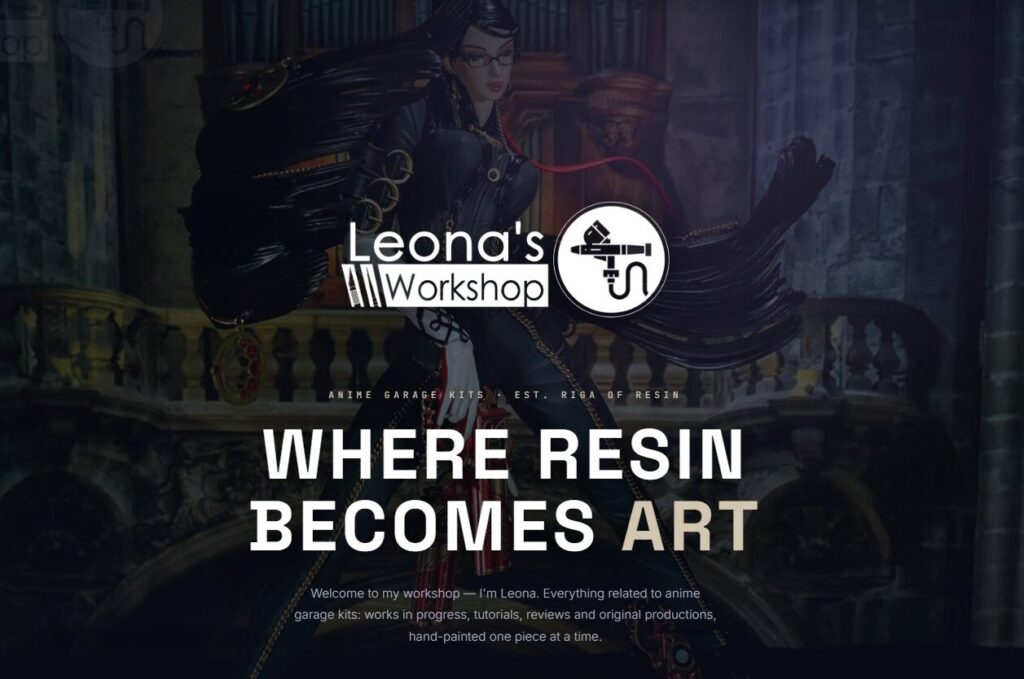
Leona’s Workshop brings together the work of an artist specializing in anime-inspired garage kits and hand-finished resin figures, along with videos, tutorials, resources for other creators, and recommendations for tools and materials.
The existing website already contained years of galleries, editorial pages, media, and specialized knowledge. The challenge was not simply to change colors or rearrange a homepage. It was to turn that digital history into a coherent, manageable experience that could express a distinctive artistic identity without rebuilding everything from zero.
VesperaMX designed and developed a custom WordPress theme around The Museum of Resin: a dark, editorial, and immersive digital gallery where each piece is presented with the presence of an exhibit. The solution brings portfolio, video, resources, recommendations, and contact into an architecture that can evolve incrementally.
Project status: the custom theme and core experiences are working in the development environment. Final optimization, infrastructure migration, and headless commerce integration remain in progress, so this story does not present final launch or adoption metrics.
Case overview
| Area | Description |
|---|---|
| Industry | Visual arts, creator economy, and art education |
| Platform | Public website and editorial system on WordPress |
| Contribution | Discovery, UI/UX, content architecture, development, integrations, and QA |
| Status | Ongoing; core experiences completed in development |
| Primary constraint | Modernize without losing historical content or relying on fragile integrations |
The challenge
The platform needed to address several needs that often become scattered across separate websites and services:
- Present a photography-led portfolio through a distinctive visual identity.
- Preserve historical galleries and content created over many years.
- Incorporate videos and tutorials without duplicating editorial work.
- Organize educational resources and shopping recommendations clearly.
- Give the artist control over text, images, links, categories, and social channels.
- Filter contact requests that do not match the services currently offered.
- Prepare a foundation for future merchandise and commerce integrations.
- Improve navigation, accessibility, and maintainability without breaking legacy pages.
The previous website used templates, plugins, and structures accumulated over time. An indiscriminate rebuild would have put useful content and still-dependent pages at risk. Leaving the system unchanged, however, would have preserved visual inconsistencies and technical dependency.
Our approach
Turn the artistic identity into a design system
The visual direction was developed as a contemporary museum experience: dark surfaces, large imagery, editorial typography, exhibit numbering, controlled contrast, and restrained transitions.
The goal was not to decorate WordPress. It was to create a reusable language for the homepage, archives, individual pieces, tutorials, contact, and future collections. Motion was implemented with progressive enhancement and respect for prefers-reduced-motion, so the experience never depends on animation to remain usable.
Modernize incrementally
The initial mockup was converted into a functional, version-controlled WordPress theme. Instead of discarding the existing site, content types, media, and pages that continued to create value were reused.
Legacy dependencies were reviewed before plugins or templates were removed. When a historical page still required an older component, compatibility was preserved while new areas were built on a clearer architecture. This reduced the risk of a destructive migration and allowed each section to be validated in a development environment.
Put editorial control in the dashboard
The homepage, featured galleries, video areas, artist introduction, calls to action, social channels, contact content, and shopping guide were modeled with Advanced Custom Fields.
Fields and content types were registered through the theme so they remain under version control. Global settings were also created for shared information, preventing data such as social links from being tied to one specific page.
The result is a highly customized visual experience that remains manageable from WordPress: the artist can update content without editing templates or requesting a deployment for every change.
Automate content without introducing fragile dependencies
Recent videos and playlists were integrated through public YouTube feeds with caching and fallback content. This avoids requiring an API key for an editorial need that can be solved more simply and reliably.
For the shopping guide, technical analysis showed that storefront scraping would create a fragile dependency. Stores, categories, products, images, and links were instead converted into ACF-managed content. This preserves editorial control, removes recurring external-credit consumption, and reduces the chance that a third-party change will break the page.
Build workflows around the creator’s real operation
The contact form was developed as purpose-built functionality rather than a generic form configuration. It includes manageable inquiry reasons, image uploads, validation, submission records inside WordPress, and anti-bot protection without relying on an external CAPTCHA.
When a visitor selects commission requests, the interface displays the creator’s approved notice and disables submission. The same rule is enforced server-side so it does not rely on JavaScript alone.
Keep a visual website easy to navigate
Gallery content was organized by year and enhanced with lazy loading, video indicators, work type, and sensitive-content states. Images open in a lightbox whose navigation remains limited to its own collection, preventing unrelated pieces from being mixed together.
Responsive navigation includes a full-screen menu and a Ctrl+K / ⌘K command palette combining site navigation with live content search through the WordPress REST API. Tutorial resources also include instant filtering to make a growing library easier to use.
What we delivered at this stage
- A custom WordPress theme built from an original visual direction.
- An immersive homepage with hero, collection, video, editorial, artist-introduction, and contact areas.
- ACF-based administration for the homepage and key sections.
- Gallery archives and individual entries with real media, lazy loading, and PhotoSwipe.
- Editorial controls for work type, video availability, and sensitive content.
- Automatically updated video and playlist areas using RSS with caching and fallback behavior.
- A tutorial page combining video, resource links, and live search.
- An editable shopping guide with stores, categories, products, images, and affiliate links.
- A custom contact form with conditional rules, attachments, anti-bot protection, and submission records.
- Responsive navigation, hamburger menu, keyboard accessibility, and a command palette.
- Global settings for social channels and shared site elements.
- Interaction protection applied only to approved visual areas rather than blocking text site-wide.
- A delivery workflow using a private repository, feature branches, reviews, and development-environment validation.
Technology stack
| Area | Technologies and practices |
|---|---|
| CMS and application | WordPress, PHP, Custom Post Types |
| Content modeling | ACF Pro, global options, repeaters, and WordPress Media Library |
| Frontend | HTML5, SASS/SCSS, JavaScript with ES Modules |
| Navigation and search | WordPress REST API, live search, and keyboard controls |
| External content | YouTube RSS/Atom, caching, and local fallbacks |
| Media experience | PhotoSwipe, lazy loading, responsive images, and editorial states |
| Quality and delivery | Git, GitHub, feature branches, pull requests, and development validation |
Business value
Because the project remains ongoing, this story does not attribute conversion, traffic, or sales figures to the redesign. The value already visible in the solution is concentrated in six areas:
- Distinctive identity: the website no longer feels like a generic template and turns the portfolio into an experience connected to the work.
- Editorial independence: the creator can manage imagery, copy, video, resources, products, and links from WordPress.
- Audience consolidation: portfolio, learning, recommendations, and contact live within one coherent experience.
- Lower external dependency: integrations use caching, fallback behavior, and managed content instead of fragile or costly processes.
- Protection of existing investment: historical galleries, media, and pages that still create value are preserved.
- Maintainable foundation: the theme, fields, and code are organized to support new collections, integrations, and improvements without rebuilding the platform.
Current stage and next steps
The core experience has been implemented and validated in development. The next stages include image and performance optimization, SEO preparation, final plugin review, infrastructure migration, and the future headless integration of the merchandise catalog.
These activities are separated from the completed scope to communicate clearly what works today and what remains in evolution.
Why this story matters
Artist and creator websites often grow organically: first a gallery, then tutorials, video, links, a store, and multiple forms of contact. Over time, that evolution can fragment the experience and make the platform difficult to maintain.
This project demonstrates that WordPress can become a highly customized editorial and visual platform without sacrificing content administration, compatibility, or ownership. The key is not installing more plugins. It is modeling information, preserving what works, and building only the logic that makes the project different.
Has your creative website stopped representing the quality of your work?
VesperaMX can help transform an existing WordPress site into a custom, manageable experience prepared to connect portfolio, content, community, and commerce.